


Press release
Opioid Induced Constipation Treatment Market Research Report by Geographical Analysis and Forecast to 2023

Opioid Induced Constipation Treatment Market
The number of patients suffering from opioid induced constipation is increasing across the globe. Close to 100 mn U.S. patients in 2013 were suffering from OIC, according to the American Academy of Pain Medicine. They added that this number is expected to increase as the number of people consuming opioid drugs increases. With a growing awareness of the commercial availability of a large variety of opioid drugs, people have resorted to using them for longer terms to treat chronic pains. This growing number of OIC patients – especially in North America – is expected to further drive the demand for opioid induced constipation treatment.
There is, however, the competition that opioid induced constipation treatment providers face from standard laxatives. Most healthcare organizations still consider standard laxatives as the first line of treatment for OIC. Additionally, the long term adverse effects of opioid induced constipation treatments have not completely been documented.
All in all, the global market for opioid induced constipation treatment is expected to be valued at US$731.2 mn by the end of 2016. Owing to a whopping CAGR of 31.2% from 2015 to 2023, this revenue is expected to reach US$4.8 bn by 2023.
This 91 page report gives readers a comprehensive overview of the Opioid Induced Constipation Treatment Market. Unlock the hidden opportunities in this market: http://www.transparencymarketresearch.com/opioidinduced-constipation-treatment-market.html
North America has always taken up a large chunk of the global consumption of opioid induced constipation treatment drugs. By the end of 2023, North America alone is expected to generate US$4.05 bn of the global revenue from opioid induced constipation treatments. This region also leads in terms of growth rate of demand, owing to the large percentage of population that consumes opioid drugs and suffers from OIC. This comes from a high number of patients that are suffering from chronic diseases and are resorting to opioids.
Additionally, the penetration of opioid induced constipation treatments is very low in other regions as compared to North America. This could be the reason for the high disparity of consumption rates between regions. At the moment, North America dominates in terms of opioid consumption. According to the ASIPP, the U.S. alone consumes close to 80% of the global supply of opioids.
Get accurate market forecast and analysis on the Opioid Induced Constipation Treatment Market. Request a sample to stay abreast on the key trends impacting this market: http://www.transparencymarketresearch.com/sample/sample.php?flag=S&rep_id=6862
Till the end of 2016, chloride channel activators are expected to be the more popular drug class of opioid induced constipation treatments. This trend will continue for the coming years, but in time it is predicted that mu-opioid receptor antagonists will take the leading role among drug classes. A key reason for the popularity of chloride channel activators is the high level of sales of Amitiza ever since it was approved in 2013 and used specifically for opioid induced constipation treatment.
Over time, the growing number of mu-opioid receptor antagonists being approved and their greater efficacy over other drug classes is expected to push it to the top of the charts in terms of revenue generation before 2023. This drug class will also benefit from the increasing number of prescriptions being filed for opioid induced constipation treatments due to developments that reduce their side effects.
The leading providers of opioid induced constipation treatment include AstraZeneca, Takeda Pharmaceutical Company Limited, Abbott Laboratories, Valeant, Bayer, C.B. Fleet Company, Inc., Boehringer Ingelheim, Daewoong Co. Ltd., and Cosmo Pharmaceuticals.
About Us
Transparency Market Research (TMR) is a market intelligence company, providing global business information reports and services. Our exclusive blend of quantitative forecasting and trends analysis provides forward-looking insight for thousands of decision makers. TMR’s experienced team of analysts, researchers, and consultants, use proprietary data sources and various tools and techniques to gather, and analyze information. Our business offerings represent the latest and the most reliable information indispensable for businesses to sustain a competitive edge.
Each TMR syndicated research report covers a different sector - such as pharmaceuticals, chemicals, energy, food & beverages, semiconductors, med-devices, consumer goods and technology. These reports provide in-depth analysis and deep segmentation to possible micro levels. With wider scope and stratified research methodology, TMR’s syndicated reports strive to provide clients to serve their overall research requirement.
Contact us:
Transparency Market Research
90 State Street,
Suite 700,
Albany
NY - 12207
United States
Tel: +1-518-618-1030
USA - Canada Toll Free 866-552-3453
Email: sales@transparencymarketresearch.com
Website: http://www.transparencymarketresearch.com/
This release was published on openPR.
Permanent link to this press release:
Copy
Please set a link in the press area of your homepage to this press release on openPR. openPR disclaims liability for any content contained in this release.
You can edit or delete your press release Opioid Induced Constipation Treatment Market Research Report by Geographical Analysis and Forecast to 2023 here
News-ID: 548628 • Views: …
More Releases from Transparency Market Research

Global Sodium Cocoyl Glutamate Market Poised to Reach US$ 195.2 Million by 2031 …
The global sodium cocoyl glutamate market is set to experience consistent expansion over the coming years, propelled by the rising demand for sulfate-free formulations, the continuous shift toward organic personal care ingredients, and increasing consumer awareness regarding mild and skin-friendly surfactants. Valued at US$ 178.1 million in 2022, the market is projected to reach US$ 195.2 million by 2031, advancing at a CAGR of 4.8% from 2023 to 2031.
According to…
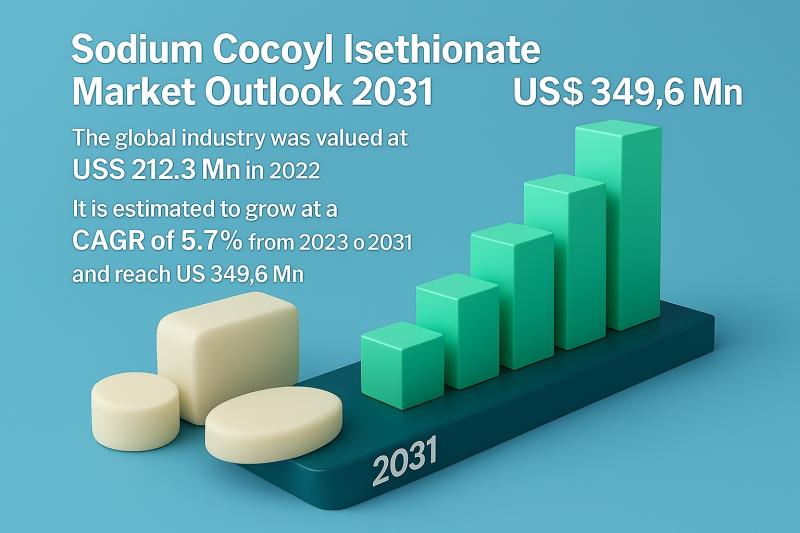
Sodium Cocoyl Isethionate Market to Reach USD 349.6 Mn by 2031 | Rising Demand f …
The global sodium cocoyl isethionate (SCI) market continues to experience robust growth as consumer preferences shift toward gentle, environmentally safe, and sulfate-free personal care ingredients. According to the latest industry assessment, the global sodium cocoyl isethionate market-valued at US$ 212.3 Mn in 2022-is set to expand at a CAGR of 5.7% from 2023 to 2031, ultimately reaching US$ 349.6 Mn by 2031.
Driven by increased awareness about skin sensitivity, rise in…
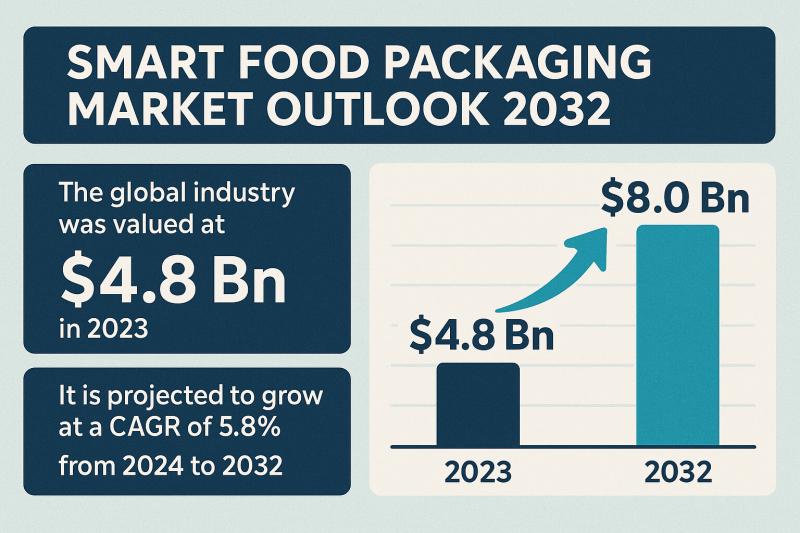
Smart Food Packaging Market Poised to Reach USD 8.0 Bn by 2032 Amid Rapid Advanc …
The Smart Food Packaging Market is undergoing a transformative shift driven by technological innovation, rising consumer safety expectations, and growing sustainability mandates across global supply chains. Valued at US$ 4.8 Bn in 2023, the market is projected to grow at a CAGR of 5.8% from 2024 to 2032, eventually achieving US$ 8.0 Bn by 2032. Intelligent packaging solutions integrating sensors, indicators, tracking systems, AI tools, nanotechnology, biotechnology, and sustainability-driven materials…
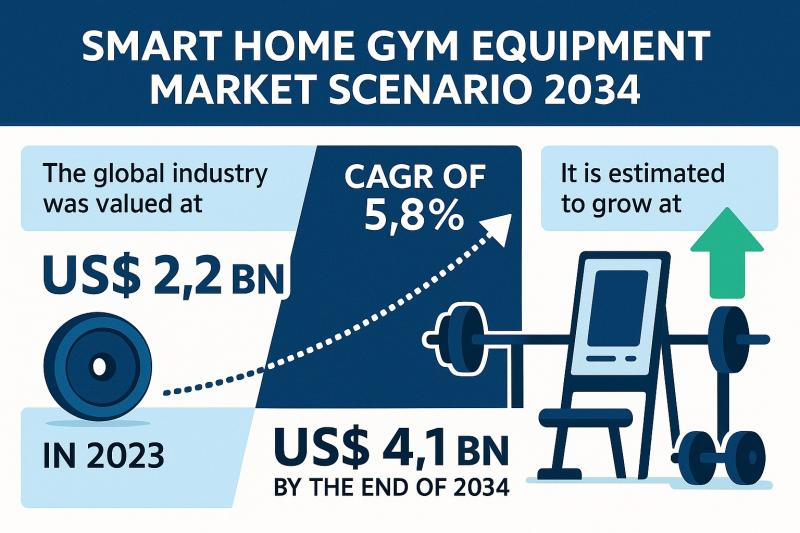
Smart Home Gym Equipment Market Poised to Reach USD 4.1 Bn by 2034, Driven by Ho …
The Smart Home Gym Equipment Market, valued at US$ 2.2 Bn in 2023, is projected to reach US$ 4.1 Bn by 2034, exhibiting a CAGR of 5.8% from 2024 to 2034. The market's strong performance is attributed to rising consumer demand for convenient home-based fitness solutions, adoption of AI-driven workout systems, and growing awareness surrounding chronic diseases such as obesity, diabetes, and cardiovascular disorders. The integration of connected devices, wearable…
More Releases for Opioid
Rising Opioid Use For Pain Management Fuels Growth In Opioid-Induced Constipatio …
Use code ONLINE30 to get 30% off on global market reports and stay ahead of tariff changes, macro trends, and global economic shifts.
Opioid-Induced Constipation Treatment Market Size Valuation Forecast: What Will the Market Be Worth by 2025?
The market size for treatment of opioid-induced constipation has seen a substantial growth recently. It is expected to escalate from a solid $1.78 billion in 2024 to an impressive $1.9 billion in 2025, exhibiting…
Growing Number Of Opioid Addiction Cases: Strategic Insights Driving Opioid Use …
Use code ONLINE30 to get 30% off on global market reports and stay ahead of tariff changes, macro trends, and global economic shifts.
How Large Will the Opioid Use Disorder (OUD) Market Size By 2025?
The market size for opioid use disorder (OUD) has experienced a quick expansion in the past few years. The growth is projected to rise from $3.96 billion in 2024 to $4.39 billion in 2025, boasting a compound…
Key Influencer in the Opioid-Induced Constipation Treatment Market 2025: Rising …
What combination of drivers is leading to accelerated growth in the opioid-induced constipation treatment market?
The rise in opioid administration for cancer and non-cancer pain is expected to drive the growth of the opioid-induced constipation (OIC) treatment market. Opioids are commonly used for managing moderate to severe pain, but they can cause constipation. OIC treatments are vital for improving the quality of life for patients on opioids, allowing them to maintain…
Top Factor Driving Opioid Use Disorder (OUD) Market Growth in 2025: Growing Numb …
How Are the key drivers contributing to the expansion of the opioid use disorder (oud) market?
The rise in instances of opioid dependency is set to fuel the expansion of the opioid use disorder (OUD) market. Opioid dependency defines a health concern marked by habitual and uncontrolled opioid consumption which negatively impacts health. These opioids can generate feelings of bliss and relief from pain, but continued usage often results in tolerance…
What's Driving the Opioid-Induced Constipation Treatment Market 2025-2034: Risin …
What Are the Projections for the Size and Growth Rate of the Opioid-Induced Constipation Treatment Market?
The market size for treatments of constipation caused by opioids has seen robust growth lately. The forecasted growth indicates an increase from $1.78 billion in 2024 to $1.9 billion in 2025, representing a compound annual growth rate (CAGR) of 7.0%. This past growth is associated with a growing elderly population, individualized treatments for OIC, the…
MEDICAL MARIJUANA AND THE OPIOID CRISIS
Marijuana from the Cannabis plant is classified as a psychoactive drug used for medical or recreational purposes. Although it has been used for decades, in the U.S., it is still illegal under federal law to use and possess marijuana.
Get PDF Sample Brochure of this report at: https://decisionmarketreports.com/request-sample/1247622
Nevertheless, at the state level, policies regarding the medical and recreational use of Cannabis vary greatly, and in many states conflict significantly with federal…
